Model Jar on Stand
Object Label
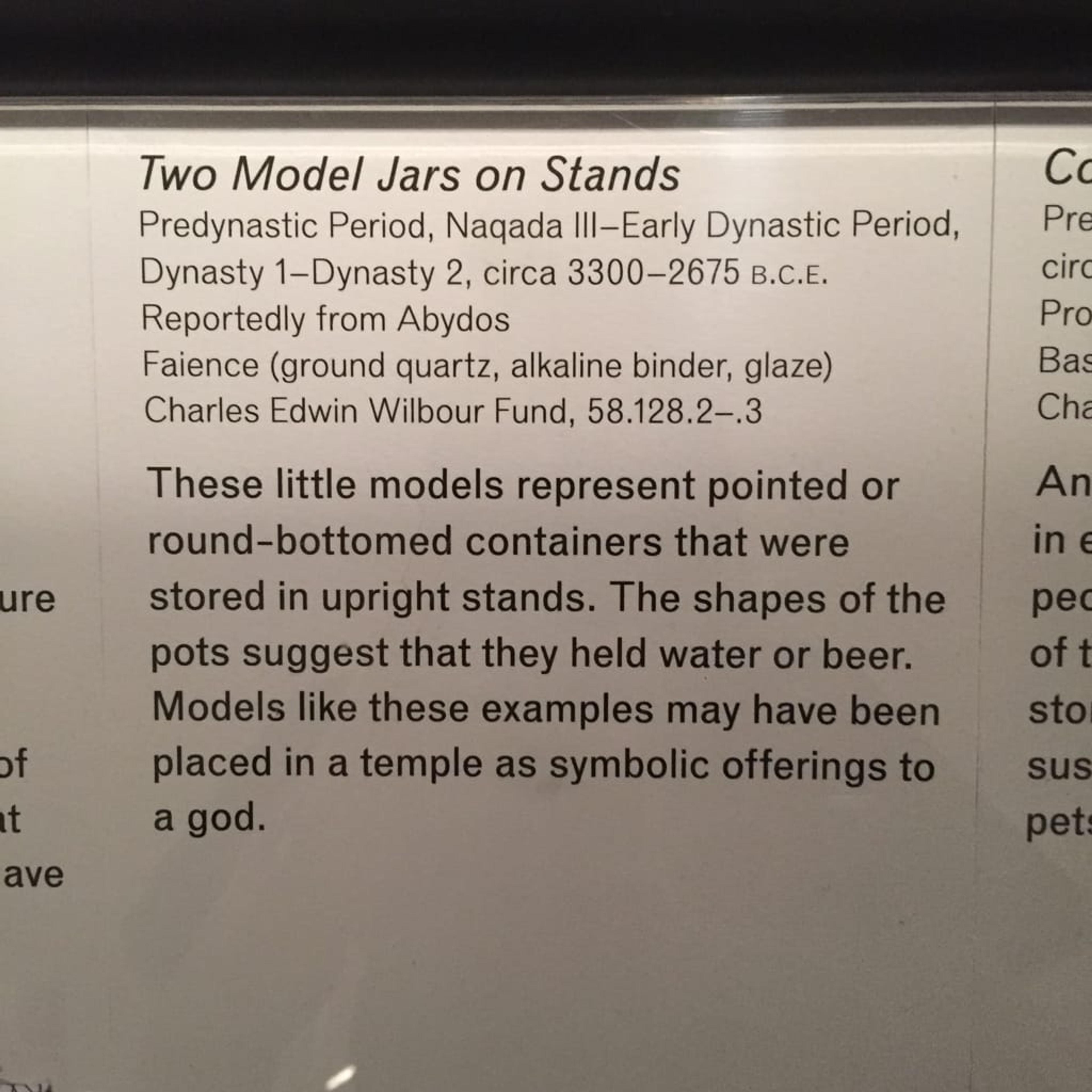
These little models represent pointed or round-bottomed containers that were stored in upright stands. The shapes of the pots suggest that they held water or beer. Models like these examples may have been placed in a temple as symbolic offerings to a god.
Caption
Model Jar on Stand, ca. 3200–2675 B.C.E.. Faience, 2 9/16 x Diam. 13/16 in. (6.5 x 2 cm). Brooklyn Museum, Charles Edwin Wilbour Fund, 58.128.2.
Title
Model Jar on Stand
Date
ca. 3200–2675 B.C.E.
Dynasty
Dynasty 1 to Dynasty 2
Period
Predynastic Period, Naqada III Period, to Early Dynastic Period
Geography
Reportedly from: el-Mahasna, Egypt
Medium
Faience
Classification
Dimensions
2 9/16 x Diam. 13/16 in. (6.5 x 2 cm)
Credit Line
Charles Edwin Wilbour Fund
Accession Number
58.128.2
Frequent Art Questions
They are so cute and smart! But aren't these containers a little bit small for water or beer?
 These ARE small, which is a good observation. Often, model versions of things would be placed in the tomb instead of full sized ones. But they would still function in the same symbolic way (to bring nourishment to the soul).Similarly, you will see little "shabties" that look like miniature mummies. These were little servants that were placed in the tomb to perform agricultural work in the afterlife. Even though they are usually miniature, they were expected to do the work of grown men!Got it. Maybe it is a religious tradition that miniatures can be represented as real in a tomb? Or because of limited resources? Why didn't the ancient Egyptians create items as the same size as real?I think you are correct that in many cases it was a matter of space, resources or money. Egyptian artists were incredibly efficient when it came to design - images tended to be refined down to their most essential parts.
Have information?
Have information about an artwork? Contact us at