Door Hinge, Model #17
Rodolphe Christesen
Caption
Rodolphe Christesen. Door Hinge, Model #17, Patented January 13, 1880. Bronze, 8 3/4 x 7 x 5/8 in. (22.2 x 17.8 x 1.6 cm). Brooklyn Museum, Gift of Kenneth W. Cordova in memory of Robert DelMonaco, 1994.59.2.
Gallery
Not on view
Collection
Gallery
Not on view
Collection
Designer
Manufacturer
Title
Door Hinge, Model #17
Date
Patented January 13, 1880
Geography
Place manufactured: New Britain, Connecticut, United States
Medium
Bronze
Classification
Dimensions
8 3/4 x 7 x 5/8 in. (22.2 x 17.8 x 1.6 cm)
Markings
Marked on reverse side of both plaques, impressed: "5 X 7 No. 17 / PAT. JAN 13th 1880."
Credit Line
Gift of Kenneth W. Cordova in memory of Robert DelMonaco
Accession Number
1994.59.2
Frequent Art Questions
Can you tell me about this?
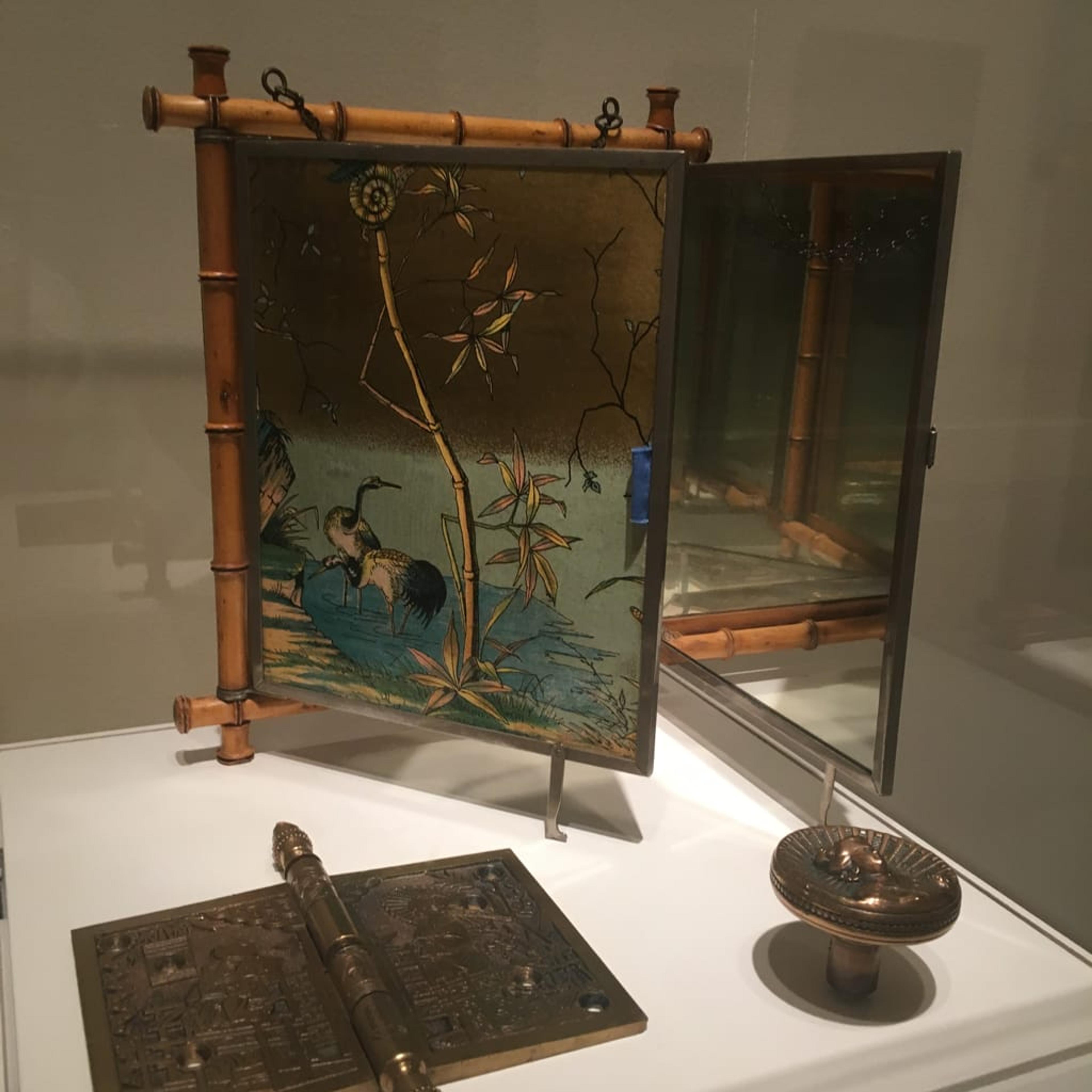 This is in a style known as Aestheticism. It is highly decorative and draws inspiration from cultures that were considered "exotic" in the 19th century, such as Japan.The motto of the Aesthetic Movement was "Art for Art's Sake", which expressed the idea that objects should be as beautiful and artistic as possible, and did not need to convey a moralistic message or even serve a utilitarian function.
Tell me more.
These objects are terrific examples of American design from the Aesthetic Movement. At this time, designers were strongly influenced by the art and design of Japan. The slogan for the Aesthetic Movement was "Art for Art's Sake." This meant that people could surround themselves with beautiful things without the expectation that it had to be moralistic or educational (as much art was earlier in the 1800s).Tell me more.
The door hinge has a Japanese-inspired scene depicted on either side. On one side of the hinge is a female geisha figure descending a bridge holding a parasol. In 1880, when this design was patented, many Americans had a fascination with Japanese design!
Have information?
Have information about an artwork? Contact us at