Walrus
Inuit


1 of 2
Object Label
These six objects reflect the importance of hunting to Arctic peoples. For millennia, Indigenous communities have not only relied on animals for sustenance but also incorporated parts of them, such as tusks and hide,into a variety of art forms.
Some objects, like the fishing lures displayed here, were produced for personal use, while the three stone sculptures were made to be sold. Of the commercial objects, the walrus figurine and the hunters in a model kayak are naturalistic, while the sculpture of a shaman transforming into a seal is enigmatic and likely depicts a creation story.
Some objects, like the fishing lures displayed here, were produced for personal use, while the three stone sculptures were made to be sold. Of the commercial objects, the walrus figurine and the hunters in a model kayak are naturalistic, while the sculpture of a shaman transforming into a seal is enigmatic and likely depicts a creation story.
Caption
Inuit. Walrus, 1950–1980. Soapstone, ivory, 2 1/4 x 1 3/4 x 4 in. (5.7 x 4.4 x 10.2 cm). Brooklyn Museum, Hilda and Al Schein Collection, 2004.79.13.
Gallery
Not on view
Collection
Gallery
Not on view
Collection
Frequent Art Questions
What do you know about this walrus? I noticed it's contemporary (1950-1980); can you say anything more about that?
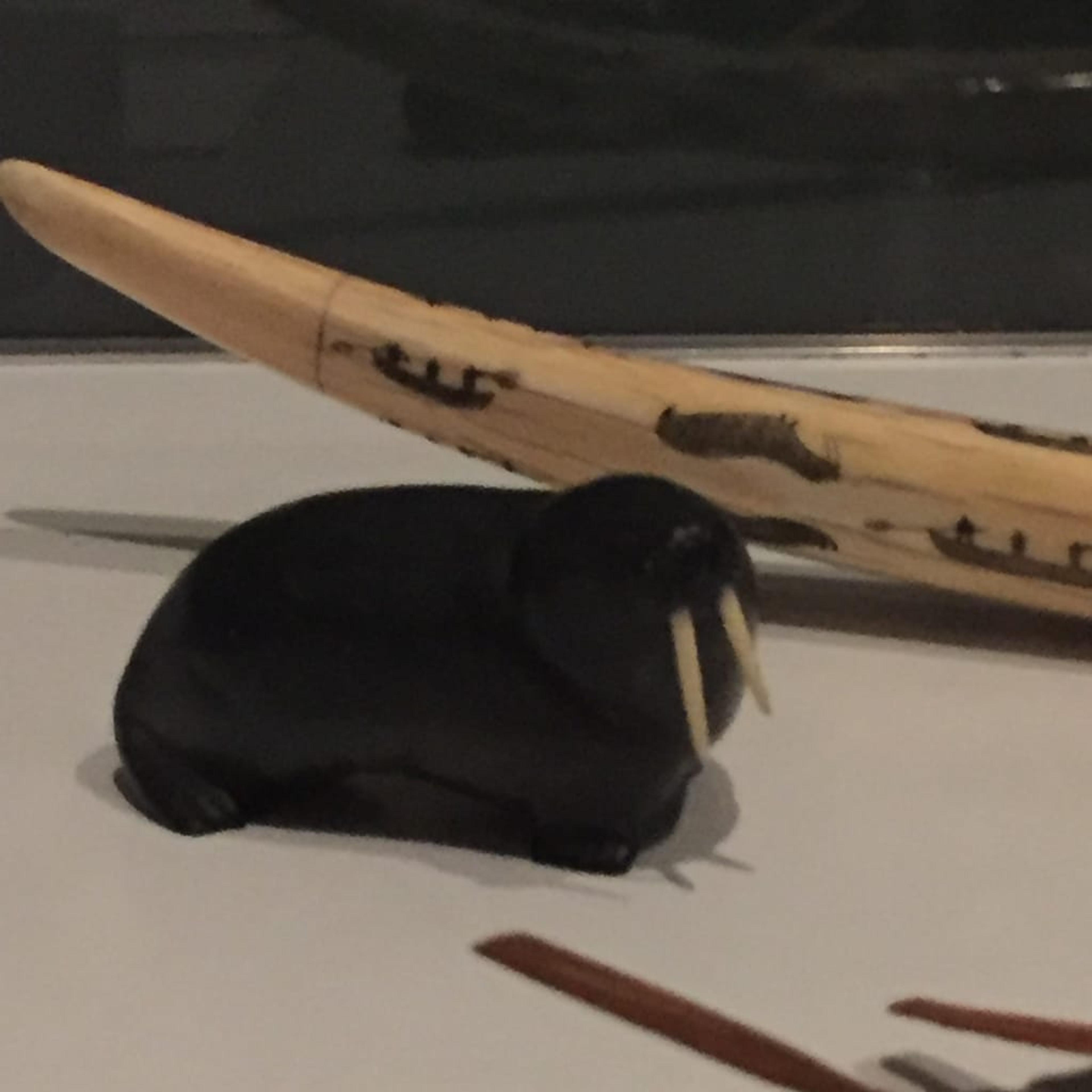 This group of objects was made in the Arctic by an Inuit artists. The Inuit traditionally didn't have a big sculpting tradition. Their seasonal lifestyle meant moving from place to place, following animal herds, etc. This discouraged the production and collecting of large art objects. Beginning in the 1940's, the government of Canada made increasing contact with the Inuit community and encouraged them to make stone carvings to be sold in southern Canada as "authentic Eskimo Art".Why did they carve a walrus? And how did the museum get it?Artists carved animals that were familiar to them such as polar bears, walruses and birds. The walrus's tusks are made from real walrus ivory. Inuit artists had experience carving ivory for fish hooks and other tools. The museum was given this sculpture in 2004 by Hilda and Al Schein.What purpose did this have, most likely?It is a sculpture made for sale. Today, stone carving is a major source of income for the Inuit community.
This was meant to be sold as "authentic?"
Yes, consumers believed works like this to be an authentic expression of the culture. In some ways, you could argue it is, because the animals were such an important part of the Inuit way of life. Today, stone carving is a major source of income for the Inuit community.Of course, and this happened in the 1940s?It began in the 1940s and then there was a flood of sales in the 1950s that hasn't really stopped since!
Have information?
Have information about an artwork? Contact us at